
PPAFI
Established in 1986
Lipa City, Batangas, Philippines

PPAFI
Established in 1986
Lipa City, Batangas, Philippines
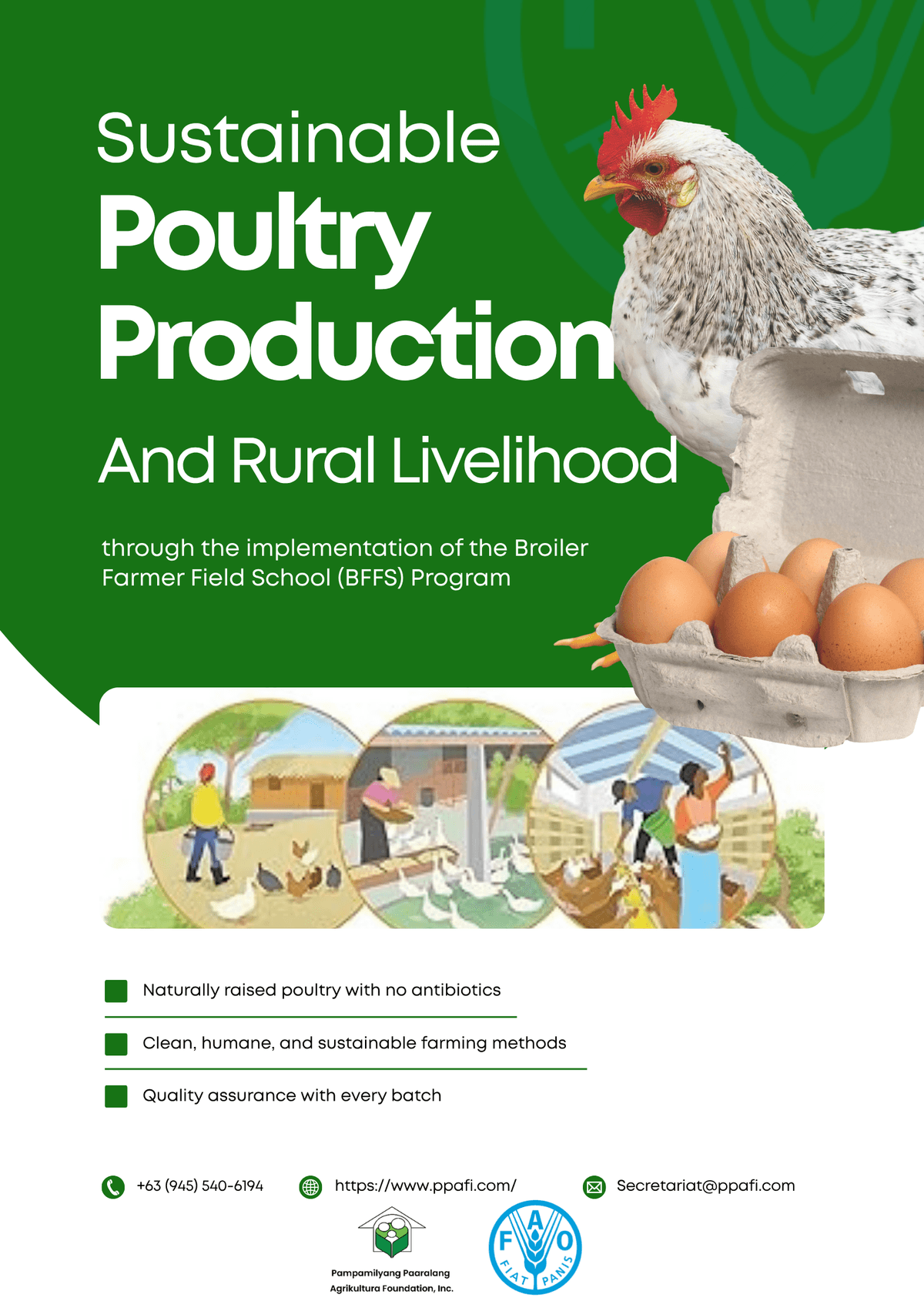
PPAFI Collaboration with FAO of UN: Strengthening Sustainable Poultry Productionand Rural Livelihoods Through the Broiler Farmer Field School Program: Experiences from Dagatan and Balete Family Farm Schools in the Philippines
Abstract:
Sustainable poultry production plays a vital role in improving food security, rural
livelihood, and agricultural entrepreneurship among smallholder farmers in the
Philippines. This paper examines the implementation of the Broiler Farmer Field
School (BFFS) Program, a collaborative initiative between the Food and Agriculture Organization and the Pampamilyang Paaralang Agrikultura Foundation, Inc. aimed at enhancing practical competencies in broiler production among farmers and young agricultural learners. Implemented in two recipient institutions— Dagatan Family Farm School and Balete Family Farm School—the program adopted a Farmer Field School approach emphasizing experiential, participatory, and community-based learning. Across three broiler production cycles involving twenty farmer participants, the project facilitated capacity-building in poultry management, antimicrobial resistance (AMR) awareness, farm biosecurity, feeding systems, disease prevention, agribusiness management, and sustainable agricultural practices. Findings from the implementation indicate positive outcomes in farmer engagement, technical competency development, confidence-building, and practical exposure to modern broiler farming systems. The initiative demonstrates the potential of experiential agricultural education in strengthening resilient livelihoods and fostering youth participation in sustainable food production systems.Introduction
The poultry sector remains one of the most dynamic agricultural industries in the
Philippines, contributing significantly to food production, employment generation, and rural economic activity. However, smallholder poultry farmers continue to face challenges related to inadequate technical knowledge, disease outbreaks, inefficient farm management, limited access to training, and low productivity. These constraints necessitate interventions that integrate practical agricultural education, capacity-building, and livelihood enhancement.In response to these challenges, the Broiler Farmer Field School (BFFS) Program
was implemented through the partnership of the Food and Agriculture
Organization (FAO) and Pampamilyang Paaralang Agrikultura Foundation, Inc.
(PPAFI). The initiative seeks to strengthen sustainable poultry production
while promoting rural development through practical and participatory learning
models. Specifically, the program aims to equip smallholder farmers and young
agricultural learners with essential competencies in modern broiler production,
antimicrobial resistance (AMR) awareness, farm management, biosecurity, feeding practices, poultry health management, and agribusiness development.Thispaper documents the implementation experiences of Dagatan Family Farm School (DFFS) and Balete Family Farm School (BFFS) as recipient institutions of the
program and explores the educational and livelihood implications of experiential broiler farming training.Program Framework and Methodology
The Broiler Farmer Field School Program adopted the Farmer Field School (FFS) model, a participatory and experiential learning approach that emphasizes “learning by doing.” Through this framework, participants were directly engaged in practical farm activities and decision-making processes, enabling them to gain firsthand experience in broiler production systems.
The implementation of the program formally began in October 2024 through a Training of Facilitators (TOF) conducted for the staff of Dagatan Family Farm School and Balete Family Farm School. The TOF aimed to prepare institutional facilitators and technical staff with the necessary competencies to effectively implement the Farmer Field School methodology and supervise broiler production activities within their respective schools.
Following the facilitator training, the farmer-participant training sessions were conducted in phases. In March 2025, training for twenty farmers was implemented at Dagatan Family Farm School. This was followed by the training of another twenty farmer participants at Balete Family Farm School in October 2025. These training activities were complemented by actual broiler production cycles, practical demonstrations, mentoring sessions, and field-based learning exercises.
The training covered the complete broiler production process, beginning with chick preparation and extending through feeding management, farm sanitation, disease prevention, harvesting, and product marketing.
Key learning components included:
- Modern broiler production systems
- Antimicrobial resistance (AMR) awareness and responsible poultry health practices
- Biosecurity and disease prevention measures
- Feeding programs and nutrition management
- Farm and environmental management practices
- Record-keeping and production monitoring
- Agribusiness development and entrepreneurial competencies
Theimplementation emphasized experiential learning, collaborative participation,and community engagement to ensure the practical application of acquired knowledge and skills.
Results and Discussion
The implementation of the three broiler production cycles yielded encouraging outcomes in terms of farmer participation, technical learning, and agricultural engagement. Participants demonstrated improved understanding of broiler management practices, particularly in feeding systems, poultry health monitoring,
environmental management, and farm record-keeping.Thehands-on nature of the training contributed significantly to skill acquisition
and confidence-building among farmer participants. Direct involvement in actual
broiler operations enabled learners to connect theoretical agricultural concepts with real-life farm applications, thereby strengthening practical competencies essential for productive and profitable poultry farming.Moreover,the Farmer Field School approach fostered discipline, teamwork,
problem-solving, and entrepreneurial thinking among participants. By engaging
in collective farm activities and management decisions, farmers developed a
stronger appreciation for collaborative learning and sustainable agricultural
production.Theintegration of antimicrobial resistance (AMR) awareness and biosecurity
measures further strengthened participants’ understanding of responsible
poultry management practices. Such competencies are particularly relevant in
addressing contemporary agricultural challenges associated with animal health,
food safety, and environmental sustainability.Beyondtechnical skill development, the project also served as an avenue for rural
livelihood enhancement. Exposure to modern broiler production techniques and
agribusiness concepts positioned participants to potentially improve farm
productivity, diversify income opportunities, and strengthen food security
within their communities.Institutional and Community Implications
The experiences of Dagatan Family Farm School and Balete Family Farm School
highlight the importance of institutional partnerships in advancing agricultural education and community development. Through continuous mentoring, field demonstrations, and practical training, the BFFS Program contributes to building resilient rural livelihoods and promoting sustainable farming systems.The collaboration among FAO, PPAFI, and participating institutions demonstrates a shared commitment toward empowering Filipino farmers and youth through
agricultural education, livelihood development, and food security initiatives.
In particular, the project reinforces the role of family farm schools as centers for experiential learning, youth engagement, and agricultural innovation.Conclusion
The Broiler Farmer Field School Program demonstrates the effectiveness of experiential agricultural education in strengthening sustainable poultry
production and rural livelihood development. Through three broiler production
cycles implemented at Dagatan Family Farm School and Balete Family Farm School, participants acquired practical knowledge, technical competencies, and
entrepreneurial skills essential for efficient broiler farming.The findings suggest that hands-on, community-based learning approaches can enhance farmer confidence, improve agricultural practices, and support local food
production systems. Furthermore, the integration of biosecurity, antimicrobial
resistance awareness, and agribusiness development reflects a holistic framework
for sustainable poultry enterprise management.As the program continues, the Broiler Farmer Field School serves not only as a
technical training initiative but also as a platform for cultivating future
agricultural leaders capable of contributing to resilient food systems and
inclusive rural development in the Philippines.